Bodily autonomy
Shrill: Notes from a Loud WomanBodily autonomy is the principle that a person has authority over their own body and cannot be separated from it without being diminished. In Lindy West’s account, the principle connects reproductive choice to fat acceptance: the demand that women surrender control over pregnancy and the demand that fat people treat their bodies as alien problems both make their humanity seem conditional. Autonomy is therefore not merely a matter of private preference. It is also shaped by access to care, money, social power, and the freedom to reject other people’s judgments about one’s body.
An indivisible self
West rejects the idea that a person’s identity can be separated from their body. A change in size does not reveal a truer person beneath the body; the person and body remain one. She connects this insistence to reproductive politics, where women’s bodies can likewise be discussed as if they were separate from their reproductive systems. In both cases, she sees a demand that people plead for recognition and accept that their autonomy may be granted or withheld by others.
This argument gives the book’s claim that fat is a feminist issue its force. West does not present fatness as an incidental appearance that can be detached from the self, nor does she accept that a body’s value depends on satisfying standards of size, beauty, or health. The question is who gets to define a body and what authority that definition carries. Her account treats bodily ownership as a condition of personhood, not a reward for meeting someone else’s standard.
Reproductive choice and unequal access
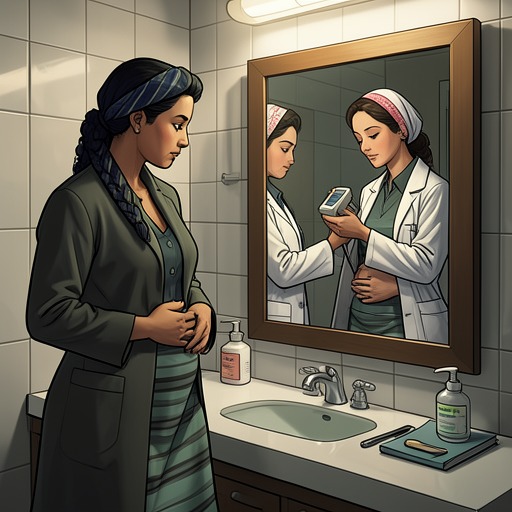
West recalls that, when she needed an abortion, she initially assumed that arranging one would be like arranging any ordinary, legal medical procedure. She was white, middle-class, living in Seattle, insured, and had seen the same doctor since she was twelve. Those circumstances shaped her expectations: she did not at first recognize how much the practical availability of care could differ from its legal status.
The cost and timing quickly made the limits of that assumption concrete. A clinic could fit her in the following week, but the charge after insurance would be $400. West had just paid rent and had about $100 in her bank account; payday was two weeks away. She did not want to wait, spend two more weeks thinking about the pregnancy, or experience further changes in her body. The decision was hers, but exercising it required confronting a financial barrier and a delay that mattered to her.
A woman who ran the clinic helped her, although West believed she could have waited until payday or asked her supportive, well-off mother for help. She remained grateful, while also questioning why she had seemed like a person worth taking a chance on. That uncertainty leads her to make privilege part of the account rather than treat assistance as proof that the system worked fairly: she notes that white women with resources can often help one another, and that people who need help least may receive it most readily. Her experience thus distinguishes the right to choose from the material ability to act on that choice.
West later places the abortion within a five-year period in which several changes in her body, work, voice, confidence, and determination came together. She does not describe abortion as inherently transformative or as a rite that made her a feminist. Its personal significance was more specific: it was her first major adult decision, a clear assertion that the life ahead was not the life she wanted. She describes the decision as a moment of taking direction in her own life rather than remaining a passenger in her body.
She also resists the demand that an individual explain an abortion in a way that might be mistaken for a justification. Her position is that the reason for someone’s abortion need not be judged as good or bad. The relevant distinction is between people who want an abortion and those who do not, and between people who can obtain care with support and those who encounter institutional obstacles or misinformation. This expands autonomy beyond personal resolve: it depends on whether people have meaningful access and support.
Fat stigma and the terms of self-worth
West’s understanding of bodily ownership develops alongside her confrontation with anti-fat attitudes. In the mid-to-late 2000s, Dan Savage was frequently discussing an alleged obesity epidemic, as public rhetoric framed fat people as a burden on health care, a problem for other passengers, or a threat to children. West observes that appeals to health could lend apparent respectability to hostility toward fat people, even when the language also treated them as unattractive, indulgent, or morally deficient. Concern presented in this form did not protect people from stigma; it helped authorize it.
Savage’s position particularly troubled West when it rejected the possibility that someone could be both obese and healthy. At the time, she was beginning to consider that her humanity did not have to depend on her body mass index, while public discussion was making fatness a target of collective alarm. The conflict shows how a supposedly medical judgment can become a demand that a person accept diminished self-worth as a condition of being taken seriously. West counters that others do not know enough about her health to make such judgments: they do not know her diet, exercise, blood pressure, or likelihood of developing diabetes. More fundamentally, she argues, those details are not a license for strangers to claim authority over her.
A different image of fat bodies helped make resistance imaginable. In Leonard Nimoy’s The Full Body Project, West encountered black-and-white photographs of fat women presented with dignity: smiling, embracing, looking directly at the camera, and arranged in poses that recalled classical figures and fashion photography. It was the first time she had seen bodies like hers honored rather than mocked. Nimoy said he had asked the models to be proud, and West began to understand that pride in her body need not be pride in spite of its size. She also recognized her bigness as a source of power.
The photographs were consequential not because they supplied a new rule for how bodies should look, but because they disrupted the assumption that fat bodies could only appear as jokes or objects of scorn. West stopped enrolling in the next session of a nutrition program as she considered whether she could refuse the framework that had made her body a secret and her value a decision for strangers. That refusal marks a shift from seeking permission to regard herself as valuable toward questioning why that permission had seemed necessary at all.
Privacy, speech, and the costs of control
West states her claim to her body without making it conditional on attractiveness, usefulness, or demonstrated health. She describes loving her body, notes that men find it attractive and that clothes look good on it, and points to the jokes her brain produces while carried around in it. These details refuse the idea that a fat person must establish the body’s appeal or social utility before claiming ownership. The body is hers whether or not it wins approval.
That claim includes a right to privacy. West argues that people who criticize her in the name of health do not know her medical circumstances and are not entitled to act as her doctors. She links such comments to the gradual erosion of her mental health over twenty-eight years. The argument does not depend on proving that her health is perfect; it rejects the premise that strangers’ concern gives them a right to inspect or manage her life.
The book also places bodily autonomy within a wider climate in which speaking against harm can carry personal risks. West describes a tense encounter in which Dave assumed Ahamefule J. Oluo was dangerous and was prepared to shoot him, despite Dave being the person who had made a threat. She reads the episode as a warning about how quickly an ordinary disagreement can become a threat of violence, and about how racial assumptions make such danger especially consequential for Black men. In this context, silence can be a response to danger, not evidence that a person has nothing to say.
West connects that pressure to the professional constraints faced by women in comedy. Female comics and writers, including some with public profiles, confided their workplace fears and frustrations to her because complaining at work could get them labeled difficult, while speaking publicly could jeopardize scarce jobs and bookings. She also recalls a frightening encounter with a drunk stranger who trapped her in a bathroom and demanded sexual access. These experiences give her insistence on speaking a concrete setting: bodily and professional boundaries may be challenged by people or institutions with greater power, while resistance may carry costs. Across reproductive choice, fat stigma, privacy, and public speech, bodily autonomy names both the right to set those boundaries and the unequal conditions under which people can defend them.